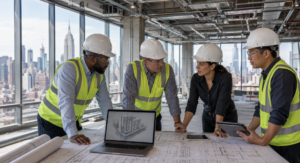
New York construction has always demanded careful planning, experienced leadership, and the ability to solve problems under pressure. Today, those demands have expanded. Buildings are no longer defined only by concrete, steel, mechanical systems, and architectural finishes. They also rely on interconnected technology that supports communications, security, business operations, building automation, energy management, and the daily experience of occupants.
This growing dependence on technology has changed the role of the owner’s representative. Owners now need someone who can protect the original vision of a project while coordinating construction professionals, technology consultants, vendors, contractors, and internal stakeholders. The owner’s representative keeps these groups moving toward the same goals instead of allowing decisions to become fragmented.
New York’s active technology economy adds another layer of urgency. Empire State Development reports that the city’s innovation economy includes hundreds of thousands of technology jobs and thousands of technology-enabled startups. As companies expand and modernize their workplaces, the line between a construction project and an IT project continues to disappear.
Technology Has Become Part of the Building
Modern commercial buildings depend on digital infrastructure from the moment their doors open. Internet connectivity, wireless coverage, access-control systems, video surveillance, audiovisual equipment, smart lighting, environmental controls, and emergency communications must operate together.
These systems cannot simply be added after construction is nearly complete. They affect electrical requirements, equipment rooms, pathways, ceilings, wall placement, cooling capacity, security protocols, and furniture layouts. A technology decision made too late can require finished areas to be reopened, wiring to be rerouted, or equipment to be replaced.
Effective Owners Representation New York services help clients address these connections during planning rather than reacting to them during installation. The owner’s representative considers how construction and IT decisions affect one another, identifies potential conflicts, and brings the appropriate experts into the process before costly work begins.
This coordinated approach is particularly important in New York, where space limitations, complicated logistics, occupied buildings, strict schedules, and multiple approval requirements can magnify the effect of even a small mistake.
The Owner Needs an Independent Advocate
Architects, engineers, contractors, technology consultants, and equipment vendors each have specialized responsibilities. Their expertise is essential, but their contracts and priorities generally focus on their individual scopes of work.
The owner’s representative occupies a different position. This professional evaluates decisions from the owner’s point of view, looking at cost, schedule, performance, risk, and long-term operational value. Rather than promoting a specific system or installation method, the representative helps determine whether a recommendation supports the owner’s broader objectives.
Independence becomes especially valuable when construction and technology interests compete. A contractor may prefer the fastest installation method, while an IT department may need more capacity for future growth. A technology vendor may recommend advanced equipment that exceeds the project’s actual requirements. The owner’s representative helps separate essential investments from unnecessary additions while protecting the infrastructure needed for long-term use.
That responsibility reflects the wider importance of technology in New York’s built environment. The New York City Department of Design and Construction manages projects ranging from public buildings to essential infrastructure, illustrating the scale and variety of work that must be coordinated across the city.
Early IT Planning Prevents Expensive Rework
One of the most valuable contributions an owner’s representative can make is bringing IT considerations into the project early. Technology planning should begin during programming and design, not shortly before occupancy.
Early planning allows the project team to identify the owner’s operational needs, required systems, security expectations, data-storage requirements, equipment locations, and future expansion plans. These decisions can then be incorporated into architectural, mechanical, and electrical drawings.
Without this coordination, a project may reach the installation stage before anyone discovers that a telecommunications room lacks adequate cooling, electrical service, clearance, or cable pathways. Conference rooms may be constructed without the connections needed for audiovisual equipment. Security devices may require new wall penetrations after finishes have been installed. Wireless access points may be placed wherever installation is easiest rather than where coverage is strongest.
Digital planning is already influencing major public construction practices. The New York State Department of Transportation’s Digital Delivery initiative emphasizes using technology and digital data throughout design, construction, and long-term asset management. The same principle applies to private development: information is most valuable when it supports the project throughout its full lifecycle.
Centralized Communication Reduces Project Confusion
Complex projects generate an enormous volume of information. Drawings, specifications, proposals, change orders, meeting minutes, schedules, submittals, and inspection records may be distributed among dozens of participants.
When communication is not centralized, separate teams can begin working from different assumptions. A contractor may proceed with an outdated drawing. A technology vendor may not receive notice of a schedule change. The owner’s operations team may approve a system without understanding its effect on construction.
The owner’s representative creates structure around these exchanges. Decisions are documented, responsibilities are assigned, and unresolved matters are tracked. This does not eliminate every project challenge, but it prevents important issues from disappearing between departments.
Technology platforms can strengthen this work by providing shared access to project records, current documents, schedules, and action items. The New York City Department of Design and Construction’s Technology and Innovation division demonstrates how application support, networks, infrastructure, and portfolio-management tools can advance the timely and cost-effective management of capital projects.
The technology itself is not a replacement for leadership. Its value depends on consistent use, accurate information, and clear accountability. The owner’s representative helps establish that discipline.
Cybersecurity Is Now a Construction Concern
Connected buildings introduce risks that traditional construction planning did not always address. Access-control systems, surveillance networks, building automation, elevators, HVAC controls, and energy-management platforms may exchange information across internal networks or cloud-based services.
If cybersecurity is considered only after installation, the owner may inherit systems with weak passwords, outdated software, unnecessary network exposure, or unclear responsibility for updates. Construction decisions can therefore affect digital security long after the project has been completed.
New York has made infrastructure security an important public priority. The state’s Office of Information Technology Services provides cybersecurity leadership, standards, and coordination for government operations. The New York State Critical Infrastructure Protection Unit also works with public and private partners to strengthen the security and resilience of essential assets.
An experienced owner’s representative helps ensure that cybersecurity expectations are included in project requirements, vendor evaluations, testing procedures, and turnover documentation. This can include confirming who will maintain each connected system, how access credentials will be controlled, when software must be updated, and how the system will be isolated if a security problem develops.
Budget Oversight Extends Beyond the Purchase Price
Technology costs are often evaluated according to the price of equipment and installation. That figure rarely represents the complete financial commitment.
Software licenses, subscriptions, warranties, maintenance contracts, replacement cycles, training, support, data storage, and cybersecurity monitoring can create recurring expenses. A lower-priced system may ultimately cost more if it is difficult to maintain, incompatible with existing equipment, or dependent on a single vendor.
The owner’s representative evaluates these long-term implications before recommendations become commitments. Competing proposals can be compared according to performance, compatibility, service requirements, expected lifespan, and total cost of ownership.
This process also helps control scope changes. Technology evolves rapidly, and project teams can be tempted to add new features during construction. Some additions provide real value; others increase complexity without improving operations. Careful review keeps spending aligned with the project’s priorities.
New York’s history as a technology center reinforces the need for informed decision-making. The development of Silicon Alley reflects the growth and geographic expansion of the city’s technology community. Building owners serving this market must provide reliable digital environments without allowing technology budgets to grow without control.
Testing and Turnover Protect the Owner’s Investment
Substantial completion does not automatically mean every system is ready for use. Equipment may be installed but not properly configured. Networks may function under light testing but fail when occupied. Security devices may operate individually without communicating correctly with the central platform.
The owner’s representative coordinates testing, training, documentation, and turnover so that problems are identified before the project team disperses. Deficiencies can be assigned to the responsible party and tracked until corrected.
A strong turnover process should provide the owner with accurate system records, warranties, licensing information, operating instructions, vendor contacts, access credentials, and maintenance requirements. Internal employees also need appropriate training before they become responsible for daily operations.
This final stage is crucial because technology problems can directly affect opening dates, employee productivity, tenant satisfaction, and public safety. A beautiful space that cannot support dependable connectivity or secure access is not truly complete.
Owners Representation Supports the Entire Project Lifecycle
The value of owners representation is not limited to resolving construction disputes or reviewing invoices. It begins with defining project goals and continues through design, procurement, construction, technology integration, testing, occupancy, and closeout.
During planning, the representative helps establish priorities and realistic expectations. During design, the focus shifts to coordination and constructability. During procurement, proposals and vendor qualifications receive careful review. During construction, the representative monitors progress, documents decisions, and protects the owner from avoidable changes. During turnover, attention moves to testing, training, records, and operational readiness.
This continuity gives the owner a consistent source of information from beginning to end. It also reduces the risk created when different consultants address isolated parts of the project without understanding its complete history.
Conclusion
The convergence of IT and construction has permanently changed complex development in New York. Technology now influences design, budgeting, scheduling, security, operations, and the long-term value of a property. Treating IT as a late-stage installation creates unnecessary risk.
Owners representation provides the coordination needed to manage these overlapping responsibilities. By serving as the owner’s independent advocate, the representative connects technical requirements with construction realities, identifies conflicts early, controls costs, documents decisions, and guides systems through testing and turnover.
As New York buildings become more connected and operational expectations continue to rise, successful projects will depend on more than excellent design and capable construction. They will require leadership that understands how physical spaces and digital systems must work together from the first planning meeting through the first day of occupancy.

Gertrude Gordon
Related Posts
- 4 months ago