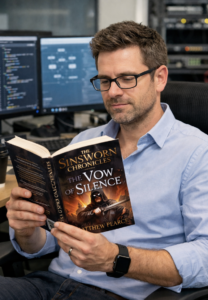
IT professionals spend much of their day inside systems, logic, tickets, architectures, security layers, cloud environments, and the constant pressure of solving problems that never seem to stay solved for long. That kind of work can be meaningful, but it also demands sustained concentration, emotional endurance, and the ability to think clearly while everything around you keeps changing. Because of that, the best reading choice for someone in tech is not always another business title, another technical manual, or another productivity book. Sometimes the smartest choice is a novel that restores imagination while still rewarding the mind.
That is one reason The Sinsworn Chronicles, Book I: The Vow of Silence stands out as a compelling read for an IT professional. Positioned within the broad tradition of fantasy literature, this novel offers much more than escape. It gives the reader a layered world, strong stakes, moral complexity, and a central story built around prophecy, exile, silence, faith, loyalty, and redemption. The premise alone is gripping: Elaran, a silenced former prince marked by prophecy, is forced into a dangerous journey alongside damaged, hunted, and morally burdened companions in a world scarred by power and fire.
For a reader in the technology field, that setup is not simply entertaining. It is energizing. Fantasy, at its best, strengthens imagination, stretches pattern recognition, and reintroduces the reader to the kind of expansive thinking that technical careers can sometimes compress. The Vow of Silence is a great young adult fantasy novel for an IT professional to read because it respects intelligence, rewards focus, and delivers a story world rich enough to pull a technically minded reader completely out of the noise of the workday and into something larger.
It Gives the IT Mind a Different Kind of Complexity
People in IT are often drawn to structure. They work with dependencies, layers, rules, permissions, hidden weaknesses, and systems that behave one way on the surface and another way underneath. That is exactly why a fantasy novel with depth can feel so satisfying. A shallow story will not hold the attention of someone accustomed to diagnosing what is happening beneath visible symptoms. A strong fantasy novel, however, invites the same analytical instinct in a more imaginative direction.
The Vow of Silence appears built for that kind of reader. Its world is not just decorative. It carries prophecy, sacred rites, political pressure, spiritual burden, and interpersonal fracture. That matters. An IT professional is rarely impressed by surface-level design. They want internal consistency. They want stakes that make sense. They want the feeling that every layer of the world has implications for the next. This is one reason speculative fiction continues to resonate with technically minded readers, and even technologists themselves have long spoken about the lasting power of story, as seen in IEEE Spectrum’s feature on the books that made a difference.
For a young adult fantasy novel to truly land with an adult working in tech, it has to do more than move quickly. It needs to create a framework the reader can inhabit. The Vow of Silence offers a ruined kingdom, a corrupted religious force, prophetic tension, and a fellowship formed under pressure. That kind of narrative structure gives the reader something to mentally map, follow, and decode. In that sense, the novel does not ask an IT professional to stop being analytical. It simply gives that analytical energy a more meaningful and emotionally rewarding landscape.
It Restores Imagination Without Feeling Frivolous
One of the hidden costs of a demanding technology career is the slow erosion of wonder. The more a person lives in response mode, the easier it becomes to view every hour through utility alone. Reading fantasy interrupts that pattern. It reminds the mind that imagination is not weakness. It is part of mental range.
That is especially relevant now, when people in technology are being asked to pair technical skill with creativity, adaptability, and long-term thinking. The value of imaginative engagement has been recognized even in engineering and technology circles. IEEE Spectrum’s article Unleash Your Inner Asimov explored the idea that engaging with speculative stories can expand how technical people think about the future. That principle matters here. A novel like The Vow of Silence does not pull an IT reader away from useful thought. It supports useful thought by opening mental space that routine tasks often close down.
This is one of the great strengths of young adult fantasy when it is done well. It tends to retain emotional urgency. It remembers how much is at stake when identity is still forming, loyalties are still being tested, and the world still feels full of danger and meaning. For adults, especially professionals with mentally intense jobs, that can be refreshing in a way that is hard to duplicate elsewhere. The Vow of Silence channels that energy through a story of exile, burden, grace, and fellowship. That makes it feel purposeful rather than lightweight. The novel offers wonder, but it does not abandon seriousness to get there.
It Supports Empathy, Perspective, and Human Insight
Technical work can be deeply collaborative, even when it appears solitary from the outside. Teams need communication. Security requires anticipation of human error. Leadership requires patience. Client management requires reading people well. Even the best architect or systems engineer still works in a human environment. That is why fiction has enduring value for professionals in highly analytical fields.
Research published through the National Library of Medicine has examined how fiction reading can influence empathy. That does not mean every novel automatically transforms a person, but it does reinforce an important idea: entering a story world and following characters through conflict can deepen emotional understanding. For an IT professional, that is not a side benefit. It is part of becoming more effective in real environments where technical skill and human judgment must work together.
The Vow of Silence appears especially suited to that kind of reading experience because its core characters are not polished archetypes. They are wounded, hunted, burdened, and tied together by forces larger than themselves. That creates room for emotional movement. The reader is not just processing events. The reader is tracing motive, pain, loyalty, distrust, sacrifice, and moral consequence. Those are the kinds of narrative elements that make fantasy memorable. They also make it useful in the best sense of the word. A book that trains the mind to track people more carefully has real value for anyone whose career depends on navigating both systems and human behavior.
It Offers Relief From Burnout While Still Rewarding Focus
Burnout is a real issue in technology. There is always another update, another outage, another deployment, another credential, another escalation, another deadline. Continuous learning is essential in the field, but that reality can also produce mental fatigue if every form of reading starts to feel transactional. Industry publications like CIO regularly emphasize the importance of continuous learning, but sustainable growth also depends on how a person restores attention, not just how they spend it.
That is where a novel like The Vow of Silence becomes more than entertainment. It gives the mind a high-quality form of recovery. Not passive scrolling. Not fragmented consumption. Not another pile of how-to content. Real reading. Long-form reading. Immersive reading. The kind that lowers noise and brings concentration back into one place.
For IT professionals, that matters because focused reading exercises a different kind of endurance than work does. It asks for presence without stress. It holds attention without forcing reaction. It creates a rhythm that can actually help a reader rebuild mental stamina. In a time when screens are everywhere and attention is under constant assault, there is real value in choosing a fantasy novel that is immersive enough to keep a busy technical mind engaged. The Vow of Silence appears to offer exactly that kind of immersive pull, pairing a substantial world with emotional stakes strong enough to keep the reader invested.
It Connects With the Best Instincts of the Tech Audience
There has always been a strong overlap between fantasy readers and people who work in technical fields. That overlap is not accidental. Both groups are often drawn to systems, rules, lore, pattern recognition, hidden structure, and worlds that operate according to meaningful internal logic. Many IT professionals also enjoy gaming, science fiction, worldbuilding, and speculative storytelling for similar reasons. They appreciate design, consequence, and layered environments.
At the same time, the strongest stories do not merely entertain the intellect. They challenge judgment. They make readers think about power, sacrifice, truth, authority, and personal responsibility. That is where The Vow of Silence looks especially appealing. Its themes of broken faith, reluctant fellowship, prophecy, and grace give the book weight. It promises the kind of story that can satisfy a reader who wants more than action alone.
That blend is important in an era when professionals are also rethinking what strengthens judgment in the age of automation and AI. Articles like Forbes’ discussion of critical thinking in an AI age reinforce the ongoing value of deep reading. Technology can speed up tasks, but it cannot replace the mental discipline built by sustained attention to complex narrative, moral tension, and layered interpretation. A good fantasy novel still trains the reader in concentration, inference, and reflection. The Vow of Silence is the kind of book that can serve that role while remaining emotionally compelling and highly readable.
It Is Young Adult Fantasy With Enough Depth for Adults
Some adults in technical careers hesitate when they hear the phrase “young adult fantasy,” assuming it will be too simple, too familiar, or too limited in emotional depth. That assumption misses what the best YA fantasy actually does. At its strongest, the category delivers urgency, identity conflict, ethical tension, and a fast-moving sense of consequence that many adult novels fail to sustain. The best examples do not read as juvenile. They read as direct, vivid, and alive.
The Vow of Silence appears to land in that stronger category. Its premise is ambitious, its emotional register is serious, and its world carries enough burden and mystery to appeal beyond a narrow age bracket. The inclusion of prophecy, inquisitors, hidden flame, sacred silence, and a fellowship drawn together under pressure gives it the sweep many fantasy readers want, while its focus on inner wounds and moral cost keeps it grounded.
That combination makes it a smart recommendation for IT professionals who want a novel that feels immersive but not bloated, imaginative but not hollow, emotionally resonant but still structurally satisfying. It offers an entry point for readers who may not have time for endless series sprawl but still want a rich fantasy experience. It also aligns with the broader leadership and perspective-building case for reading fiction explored in pieces like Forbes’ article on why leaders should read fiction. For an IT professional balancing deadlines and cognitive overload, that balance of accessibility and depth is a major strength.
Conclusion
The Sinsworn Chronicles, Book I: The Vow of Silence is great young adult fantasy novels for an IT professional to read because it delivers what many people in tech quietly need more of: immersion, imagination, emotional depth, moral complexity, and sustained focus. It gives the analytical mind something worthy to explore, but it does so through story rather than stress. It offers relief from the repetitive pressures of technical work without becoming shallow. It invites thought, not just distraction.
For the IT professional who spends day after day solving practical problems, this novel offers a different but equally valuable experience. It provides a world to enter, characters to follow, themes to wrestle with, and a sense of wonder that can sharpen rather than soften the mind. In a profession that demands constant adaptation, reading the right fantasy novel is not indulgence. It is part of staying mentally alive, creatively engaged, and emotionally grounded. The Vow of Silence stands as the kind of YA fantasy that can meet that need with both heart and substance.
